After The Session: Doubles and Stacks, Reverbs and Effects: Teaching Vocal Production Skills
Wednesday 23rd September 2026
Voice Study Centre
Kelly Hoppenjans is a vocalist, voice teacher, and PhD candidate in musicology at the University of Michigan. Here is a summary and recap of the key concepts, practical steps, and insights shared during the workshop.
Why Vocal Production Matters for Singers and Educators
Vocal production isn't just for audio engineers—it is an essential tool for modern singers and vocal educators. Kelly highlighted several key reasons why developing these skills is transformative:
- Creative Vocal Self-Awareness: Rather than listening to raw recordings purely through a critical lens, engaging in production encourages close, generous listening and creative experimentation with your unique voice.
- Crafting a Signature Vocal Sound: Understanding effects and arrangement allows artists to combine strong technique with distinct production choices (citing artists like Chappell Roan, Billie Eilish, and Phoebe Bridgers).
- Employability & Session Work: Session singing and vocal arrangement are increasingly performed remotely, making home-recording and vocal comping invaluable professional skills.
- Autonomy and Independence: Learning basic production gives singers the power to self-release music, create high-quality song demos, and communicate effectively with producers.
The 4 Steps of Vocal Production:
The workshop walked participants through a structured, four-step workflow for producing vocals:
1. Simple, Effective Recording Techniques
You don't need a multi-thousand-pound studio setup to record great vocals. As Kelly pointed out, hit songs have been written and tracked on mobile devices.

- Essential Setup: A laptop/phone/tablet, a simple microphone, and wired headphones. (Note: Avoid Bluetooth headphones during recording due to audio latency/delay).
- Acoustic Environment: Small, soft spaces yield the best results. Recording in a closet surrounded by clothes or using a heavy blanket creates a great DIY vocal isolation booth by deadening room reflections.
- Managing Gain vs. Volume: Gain controls the input level going into your DAW, while volume controls what comes out of your speakers/headphones. Keep input gain around 75%—in the green zone—to avoid harsh digital clipping and distortion.
- The Performance Mindset: Mics pick up intention and nuance. Always stay focused on the emotional delivery and narrative of the song while tracking.
2. Vocal Comping (Compiling the Best Takes)
Comping is the process of taking multiple recorded takes of a lead vocal, selecting the best sections from each, and combining them into one seamless master lead track.
- Surgical Cuts: Making slices during natural pauses or breath moments makes edits unnoticeable.
- Hands-on Practice: During the workshop, attendees used BandLab to slice ("S" key) and arrange three separate vocal takes provided by Kelly into a polished lead track.
3. Vocal Arranging: Thinking in Space, Pitch, and Time
Vocal arranging involves building supporting vocal layers around the main lead vocal. Kelly categorised background vocal (BGV) techniques into two main approaches:
Parallel / Matching Layers
- Doubles & Triples: Exact duplicates of the lead vocal line tracked on separate takes. Common in pop and indie music, doubles add intensity to choruses or create an intimate, folk-style closeness (e.g., Elliott Smith or Phoebe Bridgers).
- Parallel Harmonies: Singing a 3rd above or below the main melody following its contour, or using a pedal tone (holding a single pitch, like the 5th degree of the key) to create rich, suspended chords.
Space-Filling Layers
- BGV Pads: Sustained, synth-like vocal chords held on "ooh," "aah," or hums that form a warm harmonic backdrop (e.g., Billie Eilish’s When the Party’s Over).
- Call & Response / Echoes: Filling natural pauses in the lead vocal with rhythmic answers or direct vocal repeats.
- Descants: Soaring, high lines and melismas layered over a final chorus for dramatic impact.
4. Mixing and Creative Effects
Mixing is about creating an immersive 3D sonic space for the listener.
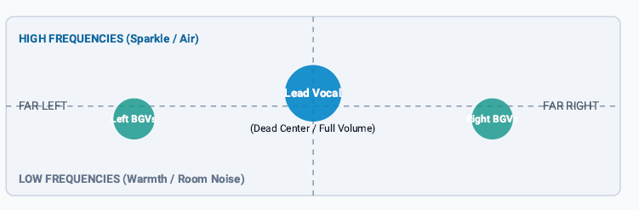
- Panning (Left/Right): Place your lead vocal dead-center. Pan harmonies, doubles, and backing layers to the left and right to separate them in the stereo field and avoid clutter.
- Volume (Foreground/Background): Always adjust volume after panning, as stereo placement naturally changes how loud a track sounds. Keep backing vocals softer than the lead.
- EQ (Equalisation): Use EQ to clean up low-end room noise (filtering out frequencies below 100–200Hz on higher voices), add warmth around 300–400Hz, or boost high frequencies above 5kHz for top-end "sparkle".
- Compression: Smooths out dynamic range by controlling volume peaks while preserving the natural performance expressive contour.
- Reverb & Delay: Reverb simulates room acoustics (e.g., hall, cathedral, booth), whereas delay creates distinct rhythmic repetitions and echoes.
- Pitch & Formant Processing: From subtle Auto-Pitch to creative pitch-shifting, pitch correction, and robotic vocoder effects (e.g., Imogen Heap), pitch manipulation offers endless stylistic possibilities.
Software and Recommended Tools for Beginners
Throughout the session, Kelly recommended several accessible platforms for singers and students starting their production journey:
- BandLab: Free, browser-based, highly accessible for beginners and classroom teaching.
- GarageBand / Logic Pro: Excellent iOS/macOS options with intuitive touch controls for younger learners or those upgrading to professional DAWs.
- Soundtrap & FL Studio Mobile: Great cross-platform options for phones, tablets, and laptops.
- CapCut: Useful for young students exploring quick multi-screen video/audio vocal arrangements.
Final Takeaway: Trust Your Ears
Perhaps the most reassuring piece of advice from the course was Kelly's golden rule for audio processing: "If you can't hear the effect, you don't need it."
Vocal production isn't about following strict rules or accumulating expensive gear—it’s an extension of vocal artistry. By approaching DAWs as creative instruments, vocalists can gain control over their sound and unlock new dimensions in their music.
Did you miss the live short course? Keep an eye on our Voice Study Centre Courses Page for upcoming workshops, masterclasses, and postgraduate study opportunities in voice pedagogy and performance.
Recent Posts

After The Session
After The Session: Games & Gadgets: Unlocking Vocal Skills Through Movement and Play🎤✨
Voice Study Centre
Tuesday 15th September 2026Vocal technique isn't just about standing still in front of a piano and doing scales - it's an interactive, whole-body experience! In a fantastic workshop hosted by the Voice Study Centre today, Naomi Lewandoski (Northside Voice Studio, Australia) led us through an engaging session on how physical movement, somatic awareness, and everyday "gadgets" can transform vocal training.
Read More...
Student Interviews
Could a Harmonica Have a Place in the Voice Studio?
Voice Study Centre
Tuesday 8th September 2026What does a harmonica have to do with the human voice? For harmonica performer and music educator Shima Melvin, this question became the starting point for her postgraduate research with the Voice Study Centre. While developing her approach to teaching harmonica, Shima found herself struggling to explain exactly what was happening inside the instrument when she played. The mechanics of the harmonica were, in a sense, invisible.
Read More...
After The Session
After The Session: Common Medical Diagnoses and Treatments in Voice Patients
Voice Study Centre
Friday 4th September 2026Voice care extends far beyond opera stars! A voice professional includes anyone whose livelihood depends on an effective and pleasing voice - teachers, solicitors, sports coaches, secretaries, and sales personnel. Yesterday, we welcomed back Dr. Robert Sataloff MD, DMA, FACS, for a short course into the diagnosis, medical care, and surgical management of voice patients. Robert is the Director of Otolaryngology at the Lankenau Institute for Medical Research, Editor-in-Chief of the Journal of Voice, professional singer, and a conductor.. Read on for the key insights and takeaways every vocal professional, pedagogue, and performer should know!
Read More...