Course Review: Beyond the Mechanics: Vocal Injury Prevention & Performance Optimization with Jennie Morton
Wednesday 23rd August 2023
Voice Study Centre
Osteopath, author and performance coach Jennie Morton began her vocal injury prevention course by introducing the context of her background as a West End performer and the lead singer of a 20-piece swing band and how poor advice from treatment professionals during that time ignited her desire to treat performers herself. She discussed how vocal injuries are usually built up over time and how the underlying root cause needs to be addressed (e.g. breath, posture, alignment, technique).
The course attempted to look at the ‘bigger picture’ in terms of the physical and emotional factors (psycho-physiology) affecting the voice, drawing on Jennie’s expertise attained from her Master’s in Psychology. Jennie delivered a comprehensive analysis of the body as a whole, viewing it through a much broader lens than it is normally viewed by singing teachers.
A focus was placed on the myofascial system (the integration of muscle and fascia), with a detailed definition of fascia given, including its roles in the body and the importance of how it can change consistency under friction or load. Using an entertaining ‘string of sausages’ analogy, Jennie explained how many different structures contained within the same fascial strand can be affected by tension in one area of fascia.
There was also a discussion around the importance of the feet and how these can reveal a lot about other things going on in a singer’s body. This is because the feet are the beginning of a track that contains many very important muscles involved in breath, posture and vocal production. This led nicely on to talking about the ‘Deep Frontal Line’ (from Thomas Myers’ book Anatomy Trains), a particular track of fascia that begins under the sole of the foot and encompasses the diaphragm, heart and vocal muscles.
Jennie shared analysis of the arches of the feet, the plantar fascia and the domes of the body (e.g. pelvic floor, diaphragm, oral cavity), and how incorrect maintenance of these can link to vocal issues. She also discussed the concept of proprioception in the body and its relation to the angle/position of the foot. The feet and neck are important areas in proprioception; if the proprioceptors in the feet are aligned then the neck is doing less work to balance the body and there is less tension, etc. Next, Jennie demonstrated a practical foot exercise with participants which included using movements to ‘wake up’ the proprioceptors along the sole of the foot and stretch out the metatarsals.
Moving up the chain of the body, pelvic positioning was the next topic at hand. This included discussion of anterior tilt and posterior tilt, as well as the psoas muscles, and their link to diaphragm function and efficiency. Jennie talked through muscle coordination for breath too, including postural control when singing from a tilted position.
All of the previous anatomical discussions led on to how we achieve good ‘sub-glottal pressure’, the level of air pressure beneath the vocal folds which supports increases in pitch and volume but can lead to vocal strain/injury if inefficient. Jennie used another great analogy, comparing the changes in pressure to the flow of water coming out of a garden hose.
After the discussions of physical factors, came an explanation of emotions and the voice, the autonomic nervous system and how it breaks down into the sympathetic state (fight or flight, anxious) and the parasympathetic state (rest & digest, chill out) – we, as humans, are regularly flitting between the two. Jennie then explained the importance of the vagus nerve in performance optimisation as it’s a mediator of the parasympathetic state and serves all the muscles of the body, including the vocal muscles. She also went through different sound frequencies and how these can activate the sympathetic (high pitch sounds) and parasympathetic (melodic or prosodic ‘mid-range’ sounds) states accordingly.
A list of common vocal issues (e.g. muscle tension dysphonia, laryngitis, vocal cracking, GERD/GORD) was shared, before Jennie explored physical fitness and exercise and how an inability to meet the cardio-respiratory demands of performance can lead to fatiguing and increased injury risk. Then, to bring some of the earlier elements together into whole body health, she discussed the role of the diaphragm as a major pump of the lymphatic system and how full breaths result in properly cleaning out the lungs and avoiding infections. It’s also the motion of the diaphragm that activates the vagus nerve and pulls us into the parasympathetic state we need to be in to optimise performance.
This insightful, comprehensive course was rounded off with some strategies for self-regulation, strategies for vocal management, efficient breathing techniques for relaxation (parasympathetic state), and a heart rate exercise to achieve coherent heart rhythms.
Recent Posts

Director & Team News
Voice Study Centre Senior Lecturer Louisa Morgan to Present at Theatrical Voice Research Centre Conference
Voice Study Centre
Friday 19th June 2026Voice Study Centre senior lecturer Louisa Morgan will present her paper, Affective Athleticism in the Vocal Athlete: Performing Emotional Roles, at the Theatrical Voice Research Centre Conference at the University of Surrey on 26th June 2026.
Read More...
Blog
Singing as a Triple Threat: An Interview with Christine Descher on Her Newly Published Research
Voice Study Centre
Thursday 18th June 2026Watch our interview with MA Voice Pedagogy student Christine Descher as she discusses her newly published research, Singing as a Triple Threat: Performers' Experiences Across Musical Theatre Disciplines. Discover what inspired the study, the research journey behind it, and how its findings contribute to ongoing conversations around performer training, vocal health and wellbeing in musical theatre.
Read More...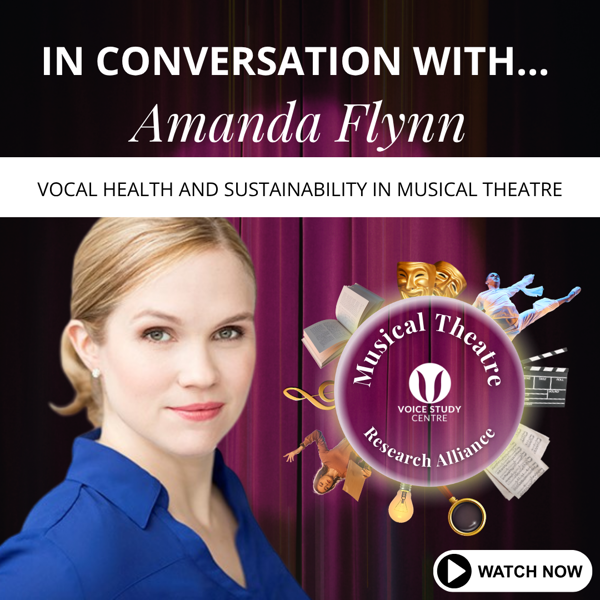
On-Demand
In Conversation with Amanda Flynn: Vocal Health and Sustainability in Musical Theatre
Voice Study Centre
Thursday 11th June 2026Watch the first conversation in the Musical Theatre Research Alliance (MTRA) and Voice Study Centre's In Conversation With series, part of Strand 1: Vocal Health and Sustainability in Musical Theatre. Broadway Vocal Coach Amanda Flynn shares her insights on vocal health, rehearsal strategies, recovery, and sustaining a healthy voice in the demanding world of professional musical theatre.
Read More...