After The Session: Applying the Meisner Technique to Singing with Jillian Paige
Tuesday 4th August 2026
Voice Study Centre
Below are the central concepts, exercises, and pedagogical insights covered during the session.
The Core Philosophy: Outside-In & Exteroception
Many vocalists struggle with a persistent tension between vocal technique and dramatic expression—feeling that prioritizing vocal precision stifles acting, while plunging into emotion compromises vocal control.
Meisner in Music addresses this gap through exteroception (the use of the senses to interact with the external environment). Grounded in explicit monitoring theory and motor learning research, the technique demonstrates that complex motor tasks (like singing) flourish when execution is trusted to subconscious processes while the performer's conscious focus remains entirely external.
"Meisner starts with the premise that 'I am enough,' and then works from the outside in. We trust that we don't need to put on anything or push—we are just here to receive." — Jillian Paige
The Performer's Pre-Practice Baseline
Before diving into technical work, performers are encouraged to establish a three-part mental and physical baseline to release performance anxiety:
- I am safe: Acknowledging and resting into physical safety.
- I am full: Recognizing that current physical/emotional energy—even fatigue—is sufficient.
- I am enough: Removing the impulse to manufacture feelings or force performance results.
Practical Application: The 3-Step Repitition Process
The classic Meisner "repetition exercise" builds the habit of active observation and instantaneous response. For singers working on solos, masterclass material, or auditions, this process breaks down into three distinct steps:
|
Step |
Focus |
Practice Directive |
|
1. Notice |
Objective Observation |
Identify raw facts without judgment (e.g., "The tempo increased," "My shoulder feels tight"). |
|
2. Describe |
Detailed Expansion |
Use sensory details or metaphors to describe the observed element as if explaining it to an outsider. |
|
3. Make Meaning |
Instinctive Response |
Allow an honest opinion or emotional reaction to form naturally, without filtering it through an "adult" lens. |
Solo Practice Framework: Choosing Your External Partner
A major challenge for singers applying acting techniques is working effectively without a scene partner on stage. The session outlined three main external "partners" a vocalist can utilize during solo practice or performance.
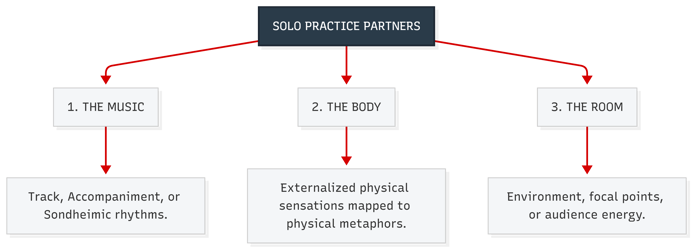
- The Body (As an External Object): Treating internal physical sensations objectively. Rather than attempting to "fix" tension or nerves, the singer observes the sensation (e.g., "My hands feel heavy") and leans into it as an anchor for the phrase.
- The Music / Accompaniment: Engaging directly with the accompaniment—treating staccato rhythms, key shifts, or melodic contours as dynamic cues from a partner.
- The Room / Environment: Anchoring focus on specific physical objects in the space or drawing off the collective energy of the audience.
Key Takeaways for Voice Teachers & Singers
- Stop "Pre-Planning" Expression: Allow dramatic choices to emerge organically in response to your chosen partner rather than locking down fixed gestures.
- Utilize "Permission to Clown": During practice, exaggerate your physical or musical observations to 100% intensity to build trust in your impulses before dialing them back for performance.
- Reframe Nerves: In the Meisner framework, stage fright or nervous energy isn't a flaw to eliminate; it is live fuel to be integrated directly into the performance.
Recent Posts
Student Interviews
Before We Change: Practicing Presence in Vocal Transformation
Voice Study Centre
Wednesday 14th October 2026Just because we can change a singer’s voice doesn’t necessarily mean we should. For Voice Study Centre MA student Chris Harbison Borgelt, meaningful voice teaching begins with a different question: who is the change really for?
Read More...
After The Session
After the Session: Musical Theatre Singing Pedagogy with Amanda Flynn
Voice Study Centre
Wednesday 14th October 2026What makes musical theatre singing different from other forms of vocal performance? And how can teachers help singers develop the flexibility, efficiency and stylistic versatility needed for a demanding professional career?
Read More...
Student & Alumni News
Foundations of Vocology Student Christie Valeriano Becomes a PAVA-Recognised Vocologist!
Voice Study Centre
Tuesday 13th October 2026We're delighted to celebrate Foundations of Vocology student Christie Valeriano's achievement of becoming a PAVA-Recognised Vocologist (PAVA-RV)! Christie shares how the course supported her journey towards this exciting professional milestone.
Read More...