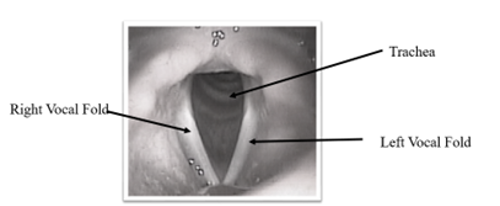
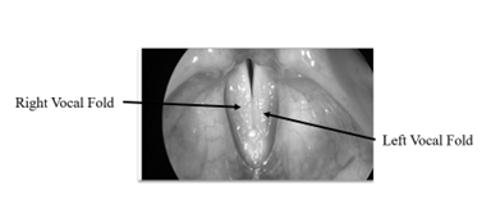
Managing breath during speech and singing has less to do with the amount of air taken in than you might expect. The vocal folds are two bands of muscular tissue that span the top of the trachea in the shape of a V. They open, or abduct, for inhalation and exhalation (Fig. 1) and close, or adduct, during breath holding, coughing, and swallowing. The vocal folds approximate (Fig. 2) to oscillate during voice production. The pitch of the voice, or frequency, is determined by the number of vibrations the vocal folds complete in one second. Loudness however is largely determined by the length of time the vocal folds remain in contact with one another during each cycle of vibration. The scientific term for this duration of time is called closed phase.
You may have seen images of the vibrating vocal folds taken from a camera that is placed in the nose or mouth. Images like the ones shown below do not give an accurate representation of the depth of the vocal folds. The tissue of the vocal folds extends downward and then inserts laterally into the walls of cricoid cartilage. A slice through one vocal fold reveals a shape that is more like an airplane wing rather than a rubber band.
In voice, the way the vocal folds approximate largely determines if the sound will be loud or soft, breathy, or non-breathy. The vocal folds naturally oscillate with a greater depth of contact between them in the lower range. This condition is sometimes called ‘thick’ vocal folds. They naturally oscillate with a shallower depth of contact in the upper range, a condition that is sometimes called ‘thin’ vocal folds. You can go from thick folds to thin folds by going from a loud voice to a soft voice. A shift in the depth of contact between the vocal folds can occur quickly or gradually depending upon how quickly you want to transition the volume of the voice. You may simulate the depth of contact between the vocal folds by experimenting with how you clap your hands. Clap your hands using only your index fingers and thumbs. Now clap your hands using the full depth of contact between your palms. Which one is louder?
The depth of contact between the vocal folds is not the only thing to consider when discussing how a tone is created. The vocal folds can approximate by using more or less force. When the vocal folds approximate with less force, they may not come all the way together and air may escape during voicing. The vocal folds are essentially the valve that regulates how quickly a person’s air is used during speech or singing. You can experiment with adduction and laryngeal valving by singing a note for as long as possible in a non-breathy tone and then again in a breathy tone. You will notice you are unable to hold the breathy tone for the same length of time. Singers may mistakenly believe they do not have enough air to sing a long phrase when the problem is in the way they adduct their vocal folds.
Most people have a total lung volume of 4-6 litres which is plenty of air to sing even the longest phrases. If you find yourself running out of breath when singing you may benefit from thinking about what you’re doing at the larynx rather than thinking about your respiration.
Recent Posts

After The Session
After The Session: Games & Gadgets: Unlocking Vocal Skills Through Movement and Play🎤✨

Voice Study Centre
Tuesday 15th September 2026Vocal technique isn't just about standing still in front of a piano and doing scales - it's an interactive, whole-body experience! In a fantastic workshop hosted by the Voice Study Centre today, Naomi Lewandoski (Northside Voice Studio, Australia) led us through an engaging session on how physical movement, somatic awareness, and everyday "gadgets" can transform vocal training.
Read More...
Student Interviews
Could a Harmonica Have a Place in the Voice Studio?
Voice Study Centre
Tuesday 8th September 2026What does a harmonica have to do with the human voice? For harmonica performer and music educator Shima Melvin, this question became the starting point for her postgraduate research with the Voice Study Centre. While developing her approach to teaching harmonica, Shima found herself struggling to explain exactly what was happening inside the instrument when she played. The mechanics of the harmonica were, in a sense, invisible.
Read More...
After The Session
After The Session: Common Medical Diagnoses and Treatments in Voice Patients
Voice Study Centre
Friday 4th September 2026Voice care extends far beyond opera stars! A voice professional includes anyone whose livelihood depends on an effective and pleasing voice - teachers, solicitors, sports coaches, secretaries, and sales personnel. Yesterday, we welcomed back Dr. Robert Sataloff MD, DMA, FACS, for a short course into the diagnosis, medical care, and surgical management of voice patients. Robert is the Director of Otolaryngology at the Lankenau Institute for Medical Research, Editor-in-Chief of the Journal of Voice, professional singer, and a conductor.. Read on for the key insights and takeaways every vocal professional, pedagogue, and performer should know!
Read More...