One Christmas Piece to Unite Them All: A Czech Christmas Tradition
Wednesday 25th November 2026
Adléta Hanžlová
This festive season, we're celebrating the rich musical traditions of our international student community.
MA Voice Pedagogy student Adléta shares her personal experiences of performing the Czech Christmas Mass, a much-loved Christmas tradition in the Czech Republic that brings singers and musicians of all ages and backgrounds together.
One Christmas piece to unite them all
During the Christmas season, it is hard to find a choir in the Czech Republic that wouldn't be preparing for a production of the Czech Christmas Mass. The Missa Pastoralis Bohemica, composed by Jakub Jan Ryba in 1796, has become part of a longstanding Czech Christmas tradition and a well-loved piece performed by ensembles all around, from high school choirs to professional musicians. I am very happy that this year, for the third time, I have been asked to perform as a soloist in the Czech Christmas Mass production of the music school I went to as a child, alongside my singing teacher from there, whom I have known since I was six years old.
Unlike the contents of a usual mass, the Czech Christmas Mass tells a charming Christmas story, following a group of villagers as they find out about the birth of Jesus and embark on a journey to visit him, preceded by various preparations. The famous opening line "Hej, Mistře!", often used to refer to the musical piece, means "Hey, master!" and is sung by the tenor soloist, a shepherd who wakes up the master (bass soloist) in the middle of the night after seeing an unusual light in the sky. The master is not pleased at first and tells the tenor off for waking him up after such a long and strenuous day at work. However, he is soon taken aback by the light and joins the villagers in their night endeavours.
The piece is one that unites singers across all different contexts, one that truly every Czech choral singer will encounter throughout their life. Because it is so widespread, a lot of opportunities arise for young or newer singers to sing a solo in a full production of a musical piece with orchestral accompaniment, an opportunity which may otherwise be hard to come by for someone who is not a professional musician. I first got the chance to sing the alto solo in the Czech Christmas Mass in the lovely coming-together-on-the-spot production organised yearly at my former high school while I was still a student there. Since then, I have sung the piece many times, both in the choir and as a soloist, and I am excited to sing it again this December. Despite the yearly repetition, it never gets old!
And the fun does not stop there. Because the mass is so widely sung and known, there is even a public production traditionally organised at the main train station in Prague. The purpose of attending this production is not simply to listen to a concert, but to join in. Everyone is welcome to come and sing or bring their musical instrument and add to the orchestra and chorus created on the spot, led by the professional conductor who is also the main organiser of the event.
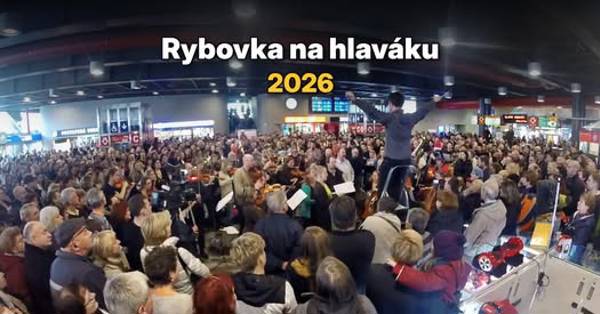
Fun fact: "Ryba" (the name of the composer) means "fish", and the traditional Czech Christmas food is fried carp. The Czech Christmas Mass has earned the nickname "Rybovka", which can be very loosely translated as the "fish mass" or "fish song". Though unrelated to the Christmas dish, there is a connection between the two in the back of a lot of Czech people's minds ;)
Adléta Hanžlová
Adléta is a phonetician and voice teacher based in Prague, Czech Republic. Currently, she is pursuing the MA in Voice Pedagogy with the Voice Study Centre as well as a PhD at the Institute of Phonetics, Charles University, where her doctoral research explores the acoustic and perceptual characteristics of timbre in the singing voice.
Recent Posts
After The Session
After The Session: A (Very) Brief Course in Linguistics! with Miranda Guettlein

Voice Study Centre
Wednesday 18th November 2026A recap of our introductory linguistics course for voice teachers, speech practitioners, actors and dialect coaches, led by Miranda Guettlein, linguist, dialect coach and editor of the Voice and Speech Review.
Read More...
After The Session
After The Session: Neurodivergence and Critical Disability Theory with Dr David Cane
Voice Study Centre
Monday 9th November 2026A recap of our session with Dr David Cane, Senior Lecturer on the Voice Study Centre MA in Voice Pedagogy, on disability and neurodivergence within the voice teaching studio. When we talk about disability and neurodivergence in voice teaching, the first thing that comes to mind is often a single question: what do I do if a disabled or neurodivergent student walks into my studio? In this session, Dr David Cane invited us to think much bigger. The teacher might be disabled or neurodivergent. So might a choir director or a colleague. The songs we teach may depict or use disability as a metaphor. Even the foundational texts of voice pedagogy carry assumptions about bodies and voices. This was a densely theoretical tour, and David was open about that. His argument was that the most important work is not a checklist of practical tips, but a rethink of what we believe teaching is for. Here are the main threads.
Read More...
After The Session
After The Session: The Vocal Health Challenges for Actors and Singers with Leda Scearce
Voice Study Centre
Wednesday 4th November 2026A recap of our two-part course with Leda Scearce, singing voice specialist and speech-language pathologist at Duke Voice Care Center in North Carolina. Over two afternoons, Leda Scearce took our community on a deep dive into the voice as a high-performance instrument. A former professional opera singer who taught at several universities before retraining as a speech-language pathologist, Leda now works with singers and other performers who have voice injuries. Her message across both days was clear: singers and actors are vocal athletes, and voice teachers are on the front lines of their vocal health. Here are the highlights from both sessions. Please note that this is a summary of a teaching session, not medical advice. If you or a student have a voice concern, see a qualified voice specialist.
Read More...