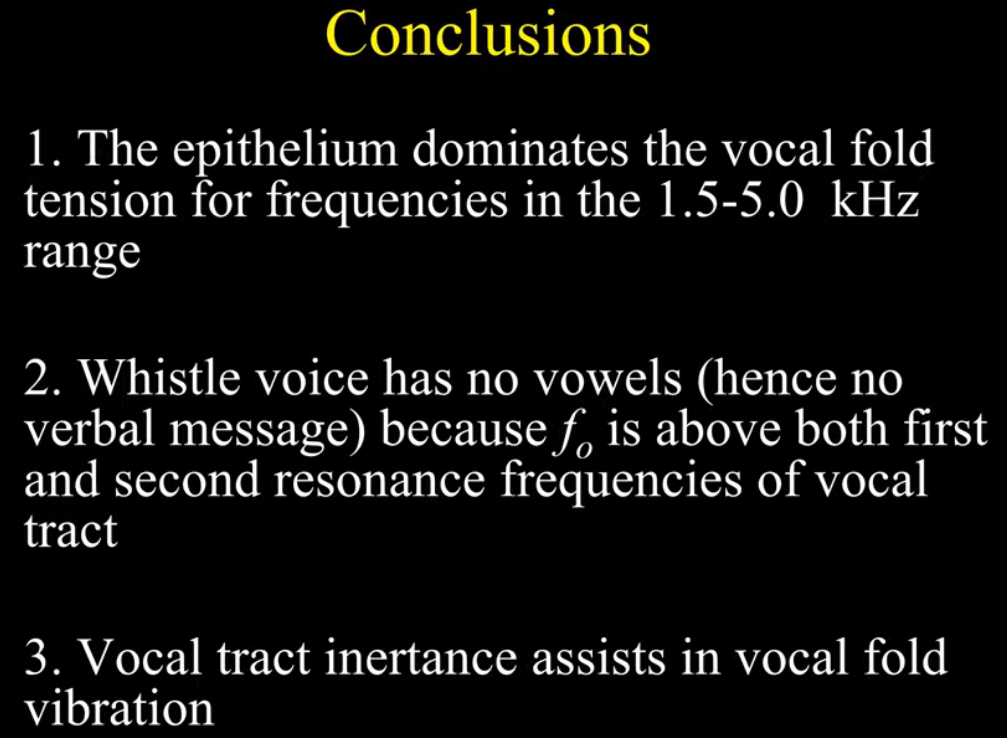
Short course review: The Acoustics and Mechanics of Whistle Voice - what did we learn? 😮💨
Monday 13th April 2026
Voice Study Centre
Educated as a physicist (Ph.D.) and engineer (M.S.E.E.), Dr Ingo Titze has applied his scientific knowledge to a lifelong love of clinical voice and vocal music. He has written over 500 publications and six books in voice production.
Before diving into the whistle register specifically, Titze defined a "voice register" as a plateau of vocal timbre (voice quality), As a singer changes their pitch, loudness, or vowel, the voice quality remains relatively stable until it hits a transition point. Crucially, "registration" is not just about the larynx; it involves the entire airway, the whole musical instrument of the human body.
The whistle register is the highest register of the human voice, sitting above the falsetto. Titze explored the biomechanical and acoustic variables that allow for these extreme frequencies:
- Vocal Fold Vibration: Unlike lower registers where the vocal folds vibrate in their entirety, the whistle register involves a specific type of vibration where only a small portion of the folds may be active.
- Acoustic Transitions: Titze illustrated how the voice moves between registers using a "step-function" model. As a physiologic or acoustic variable changes, the voice stays in "Register 1" until it reaches a transition zone, where it then shifts into "Register 2" (such as the whistle register).
- The "Whistle" Effect: The acoustics of this register are unique because the sound is produced similarly to how air moving through a small opening creates a whistle, often bypassing some of the heavier muscular involvement found in chest or head voice.
Why does this matter? Understanding the biomechanics of the whistle register isn't just for scientists; it’s vital for:
- Vocal Health: Knowing how the folds transition helps singers avoid "breaking" or straining their voices.
- Training: Teachers can use these acoustic principles to help students navigate the transition into their highest range more smoothly.
- Performance: Gaining control over these plateaus allows for consistent voice quality across a wide range of notes.
The human voice is a marvel of biological engineering. By studying the whistle register, we gain a better appreciation for the precision required to produce the sounds that define some of the most iconic moments in music.
Voice Study Centre hosts guest presenters and speakers from all over the world, all experts in their field. There is at least one short course per week; please browse our full lineup for the coming weeks. Our schedule is always changing, so check back regularly! Sign up to our mailing list for all the latest offerings..
Recent Posts
Student Interviews
How the MA Voice Pedagogy helped Blue Cain build a career as a singing teacher
Voice Study Centre
Wednesday 5th August 2026When Blue Cain joined the MA Voice Pedagogy, they weren't an established singing teacher. In this interview, they share how the programme helped them launch a career in singing teaching, discuss their experience of studying online with ADHD, and reflect on their research into gender-diverse voices.
Read More...
Course Reviews
Masterclass Insights: Applying the Meisner Technique to Singing with Jillian Paige
Voice Study Centre
Tuesday 4th August 2026Yesterday, the Voice Study Centre recently welcomed back Jillian Paige, founder of Meisner in Music, for an interactive workshop exploring how Sanford Meisner’s renowned acting methodology can be transformed into a practical framework for vocalists. While traditional acting approaches often prioritize internal character analysis or objective-driven choices, the Meisner Technique operates on a foundational principle: to sing freely and express fully, your focus must be directed outward. So what did we learn?
Read More...
Blog
How MA Voice Pedagogy Student Aramat Arnheim-Sharon Contributed to Published Voice Research
Voice Study Centre
Wednesday 29th July 2026Watch our interview with MA Voice Pedagogy student Aramat Arnheim-Sharon as she discusses her contribution to a published research chapter exploring voice, vibration, wellbeing and emerging health research. Discover how postgraduate study supported her journey into academic research, and hear about her current MA research and the development of new tools for voice pedagogy.
Read More...